The Naming of Names

The art or craft of naming things – nomenclature – is something I leave largely to my subconscious. Rarely do I come to a piece of writing, whether a novel or a short story, with the names of characters already set in stone.

So, regarding the names that my subconscious conjures up… can I look back and claim, on behalf of my subconscious, an insight that was lacking in my upper brain at the time of writing? Did the names relate to mythology, or have some deeper meaning than was at first apparent? Well, leafing through my last few novels, it would seem not. I see many routine Anglo-Saxon names, a few Indian names, and a few – belonging to aliens – that I must have made up because they sounded euphonious, or just plain right.

I tend to spend more time, for some reason, thinking about the names of things: planets, cities, starships, etc. These have to sound right, convey the correct impression, the required atmosphere. For instance, in the novel Satan’s Reach, the second book in the Weird Space sequence, I have the following names of planets: Ajanta – which sounds Indian, sultry and exotic, to me, which is the atmosphere I wanted to instil in the reader’s mind; Tourmaline (which I have an idea Ed Bryant used for a planet, too) which sounds bright and shiny, and for some reason rural; Teplican – the corruption of the name of a town in, I think, Hungary, which I came across in Anne Applebaum’s Iron Curtain: The Crushing of Eastern Europe. Teplican sounded mysterious, and indeed there is a mystery on the planet; then the next world our intrepid heroes venture to is called Vassatta – an ice world which describes a highly erratic orbit around the sun, so that a winter lasts for a hundred Terran years. Vassatta sounds a little Nordic, which worked in the context of the chapter. (I get a lot of names for planets and cities from other books, often non-fiction: I’ll read a name that resonates with me, then play about with it, change a consonant here, a vowel there, until I have something that fits.)

In the same novel I have two starships, one chasing the other, and in the first and second drafts of the book I left the names blank (or rather wrote ???, where the names should be), and only during the third go through will I give the ships names, after a lot of careful consideration.

I keep a note-book in which I jot down words which will one day become the names of planets, cities, or alien races. In France a few years ago I saw a poster for a music concert, and one of the bands was called, if my memory serves, Bokkota; this became Bokota, the name of an alien race in one of my books. Many moons ago I came across a list of words that were synonyms for kambucha – a type of fungus tea that was apparently good for the digestion (it wasn’t: it made me ill): many of these words were wonderfully alien in their own right, and found their way, altered slightly, into my fiction. One day I hope to use names lifted from Paul Theroux’s The Great Railway Bazaar: he was travelling through Malaysia by train, and at one point describes the names of a series of railway stations and comments that they sounded like the names that a science fiction writer might give to planets. Thanks, Mr Theroux.

I have a couple of favourite writers who are brilliant at giving things – people, planets, cities, societies – just the right name. Jack Vance is a genius. Open any of his books and you’ll come across wonderfully evocative names, names that combine the exotic and the commonplace but which perfectly describe whatever he’s writing about. James Lovegrove is another author who works hard at his names: he’s a wordsmith par excellence, and his novel Provender Gleed is an object lesson in the naming of things.

In my novel The Serene Invasion I have the S’rene come to Earth and stop human beings from committing violence. Of course the S’rene soon come to be known as the Serene. Their enemy are the ugly-sounding Obterek, and I have no idea where that name came from. I have a number of Indian characters in the book, and I had fun with Hindu baby name websites, matching the names and their meanings to individual characters.

But, that said – as with all my work – I owe most of what I do to that mysterious thing called the subconscious.

I power up the PC in the morning, make sure I have a cup of piping hot green tea at my elbow, then send down a silent prayer to that strata of my mind that will, for the next few hours, with luck, transport me to a world light years away from this one.

2 Comments

Filed under News

Influential Books

These are the ten most influential books on my writing career…

1) Cards on the Table by Agatha Christie. This book changed my life. I left school at fourteen when my family emigrated to Melbourne, Australia. I’d never read a novel in my life. I was bored one summer holiday, and in desperation my mother said, “Read this. It might keep you quiet.” A Pan edition of Cards on the Table. I read it and was spellbound from the first page. I finished the book and began reading it again. I find it hard to relate the revelation this piece of fiction had one me: it was shattering. To be allowed into the heads of other people, albeit fictional characters, to be given a view of the world not my own… I knew, as soon as I read the book, that I wanted to be a writer. The very next day I sat down and began plotting my first novel. It was three pages long and featured a vicar, a retired major, and a tennis party.

2) Sundance and other stories by Robert Silverberg. I read Christie religiously for months, and then while in Menzies bookstore in Melbourne saw the Corgi paperback edition of Sundance, featuring a bull-nosed starship by (I think) Chris Foss. I was captivated by the image and bought the book. It was another, even greater revelation. If Christie blew my young mind, then imagine what Silverberg did. It’s not one of his best collections, I realise in retrospect, mainly featuring tales he wrote at speed in the fifties, but it contained a story called “The Overlord’s Thumb” about a planetary governor and a tricky alien-human conflict which fired my imagination. Years later I paraphrased the opening paragraph in one of my own stories, “The People of the Nova.”

3 & 4) The War of the Worlds and The Time Machine by H. G. Wells. I’ve listed these two books together because that’s how I discovered them in an ‘Opportunity’ shop – which is what they called charity shops in Australia back in ’75 (and might still call them today) – in Mordialloc. They were bound together in a Heinemann hardback, and I think it might have been a schools edition. Anyway, the books amazed me, especially The Time Machine. It was the first time travel tale I’d read – what an auspicious starting place! – and the very idea of time travel filled me with that tingling sense of wonder that SF is all about. I was very affected by one of the final scenes in the book, when the Time Traveller stands on a lonely shore millions of years in the future, surrounded by scuttling crab-like beasts, and contemplates the vast, red fulminating sun. Vast, red fulminating suns make guest appearances in my fiction to this day. I loved The War of the Worlds, too, and recall that I was very taken by the tripods. It was shortly after reading these books that I set aside any idea of writing whodunits and concentrated on writing SF.

5) The Father Brown stories by G.K. Chesterton. Around the same time I discovered Silverberg, I came across a Penguin edition of The Wisdom of Father Brown, began reading it and found the prose too ‘hard’. It wasn’t what I was expecting from a detective story, being far too philosophical for my liking. A few years later, however, I returned to the book and loved it – loved Chesterton’s rich, alliterative, declarative prose, his poignant descriptions of the English countryside (which I lapped up as I was still in Melbourne, and homesick). I admired his turn of phrase, his alliteration, the way he used the language in a fresh and vibrant way. He’s still one of my favourite writers (I pastiched his style and featured G.K. himself in my novella Gilbert and Edgar on Mars) and I collect his work – a mammoth task as he wrote a lot.

6) Riotous Assembly by Tom Sharpe. It must have been around 1976 that I picked up this novel, Sharpe’s over-the-top satire on apartheid in South Africa. I was fifteen and knew little about the political situation there, and read the book as a comic novel about ignorance and racism. It was hilariously funny – the first funny book I’d ever read, and again it blew me away. I haven’t read it since – I’m afraid to, in case it doesn’t live up to my recollections of it – but I recall being taken by Sharpe’s prose style, his long, complex sentences, and his intercutting between scenes.

7) Titus Groan by Mervyn Peake. Skip a few years and I’m back in England; I’ve read a lot more and written lots of unpublished rubbish. I’m in my early twenties. I can’t recall how I came across this book, and was surprised I liked it. I’m wasn’t too keen on fantasy (not that this novel is strictly fantasy, though that’s what I read it as back then) and I preferred pared down prose to lush, descriptive writing. But I was taken by Peake’s descriptions, his rendering of the setting, his larger-than-life characters, and the brooding sense of menace he builds up throughout the book. I fell in love with Titus Groan’s sister, Fuchsia, and was deeply moved by her accidental death. I was captivated by Peake’s description of her, too: “She was gauche in movement and in a sense, ugly of face, but with how small a twist might she not suddenly have become beautiful. Her sullen mouth was full and rich – her eyes smouldered.” Wonderful.

8) The Drums of Morning by Rupert Croft-Cooke. This is the third volume of Croft-Cooke’s twenty-seven book autobiographical sequence entitled The Sensual World. He’s a sadly neglected writer who between around 1930 and his death in 1979 wrote over a hundred and twenty books, thirty-odd mainstream novels, the same number of crime novels under the name Leo Bruce, and books on such diverse subjects as darts, gypsies, the circus, wines, cooking, and biographies of Wilde, Lord Alfred Douglas and Kipling, as well as short stories and poetry. But his lasting legacy is The Sensual World, a brilliant evocation of his life and times – concentrating on the latter. The odd thing is that although he wrote so many volumes of autobiography, he never once mentioned the fact that he was homosexual – partly of course due to the times in which he was writing, and partly because, as he was at pains to point out, the books were less about himself than the places he travelled to and the people he met. Croft-Cooke was a non-conformist, an eternal optimist, and eternally seeking – perhaps as a rebellion against his upper-middle-class upbringing – new and varied experiences. The autobiographies bristle with incident and loving accounts of the personalities, famous and otherwise, he encountered during his varied and peripatetic life.

I came across The Drums of Morning in a junk shop in Haworth, West Yorkshire. I read it quickly and knew that I had to find the rest of the series. Over the course of the next few years I began collecting Croft-Cooke’s books, and found the story of his life, its many vicissitudes and few triumphs, as true inspiration.

9) The Girl with a Symphony in Her Fingers by Michael G Coney. A few years later I discovered the excellent and neglected SF writer Michael Coney. I recall precisely where I found this fix-up novel. It was in W.H. Smiths in Bradford, on a discount table. I picked up the Elmfield Press hardback for 50p – and bought it because it was SF. I’d never heard of the author, but the blurb sounded interesting. I devoured the novel and it remains one of my favourite SF novels. It’s not his best (Hello Summer, Goodbye or Brontomek! are technically superior novels) but it spoke to me. It’s a quiet novel about Joe Sagar, a slithe farmer, on the Peninsula. Slithes are alien creatures whose pelts, when shed, change colour according to the emotions of the wearer. Joe meets and falls for a young woman, has run-ins with the haughty and egocentric 3-V star Carioca Jones, and flies his sling-glider in the skies above the Peninsula. It’s a light read, and Joe Sagar is a wry, likable character who features in other uncollected tales set in the same milieu. This novel, and others by Coney, were the influence behind my novel Meridian Days and the series of novellas that comprise the Starship Seasons sequence.

10) Helix by Eric Brown. This might seem a stroke of blatant self-publicity, but the book was a great influence on the rest of my career as an SF writer. I’d had a trilogy out with Gollancz – the three New York books – which didn’t sell well, perhaps because Golly, in their wisdom, brought the books out over a period of five years. They then rushed out The Fall of Tartarus, with no publicity at all, then promptly dumped me. After a period in the doldrums, I had what I thought was a great idea for a big SF novel: a vast spiral of ten thousand worlds created by an enigmatic alien race as a haven for races on the edge of extinction. I wrote an opening chapter or two and a detailed ten thousand word outline, and sent it to various publishers and agents. To cut a long story short, no one wanted it. I was disappointed, to put it mildly. A couple of years later John Jarrold contacted me, knowing I was unagented, and asked if he might represent me and if I had anything he might be able to sell. I leapt at the chance and sent him the outline of Helix. He thought it sellable, and promptly sold it to Solaris. It proved to be my best-selling book, with nearly fifty thousand copies sold to date. I wrote a sequel, Helix Wars, and hope to do more in the series. The moral of the tale, keep at it and don’t let the bastards get you down. Anyway: Helix, a big influence on my career.

8 Comments

Filed under News

Writing Aliens

The thorny issue of writing aliens has vexed writers of science fiction since H. G. Wells first set pen to paper.

In a way he had it easy: he was writing about aggressive alien invaders, so described the Martians as slobbering, slimy, tentacular monsters bent on nothing more than slaughter and destruction.

But as SF became more sophisticated – especially in the area of alien relations and first contact – the problem became one of how to present alien races realistically: how to tread the fine line between making your aliens seem genuinely alien (without alienating your audience by presenting unknowable aliens) and making them comprehensible (without anthropomorphising them to the point where they resembled nothing more than cute teddy bear analogues).

Many science fiction writers shy away from depicting aliens by not writing about them at all: their argument is that aliens, when we do eventually meet them, will be so alien, products of an evolution so unlike ours, that we might not even recognise them as sentient, and that writing about them realistically is almost impossible. Other writers take the more pragmatic line, and claim that since they’re writing entertaining fictions, then they are allowed to anthropomorphise their aliens for the comprehension of the reader. For many years Keith Brooke was in the former camp; he steered away from writing about aliens until broaching the subject head on in his excellent novel alt.human (Harmony in the US), in which he presented a plethora of aliens as wholly unknowable, their motives opaque to the human race who are enslaved by the alien invaders. Other writers – H. Beam Piper springs to mind, with his Fuzzy aliens – go down the road of writing aliens as human analogues, for the sake of story-telling.

I’m often asked how I go about writing aliens.

And I answer that that depends on the type of story I’m writing. I’m a pragmatist when it comes to my fiction. I don’t mind using human-analogues if the tale I’m telling requires this. My novels Helix and Helix Wars spring to mind. In these I had to tell the story of aliens and humans from their respective points of view. In Helix I had a race of lemur-like aliens whose civilisation was the equivalent of Europe in the late nineteenth century, ruled by a draconian Church. For reasons of reader comprehension I had to make these aliens, their emotions and motivations, human-like. Likewise in the sequel, Helix Wars, the story called for three lots of viewpoint characters to be alien: a hard-bitten, pragmatic race of engineers; a fey, insect-like race of Buddhist-like creatures, and a fascistic military race. I could be accused of writing aliens, in these cases, too human to be believable, but my defence would be that the story I was telling demanded this treatment of extraterrestrials.

On the other extreme, I’ve tackled the problem of presenting aliens by not showing them on stage at all – because this strategy worked for the particular stories. In Kéthani, in which aliens come to Earth and offer human beings the gift of immortality, the Kéthani are never shown, never described. Likewise in my novel The Serene Invasion, in which aliens come to Earth and inhibit our ability to commit violence, I decided that the best way to present aliens would be to not describe them at all, and allow the readers’ imaginations to create the extraterrestrials in their absence. Often, what is left to the reader’s imagination is more powerful than any amount of description.

So, as far as I’m concerned, there are no hard and fast ways, no set rules, that govern the writing of aliens. It’s what works in the context of the tale you’re telling at the time.

It’s horses, you might say – or rather aliens – for courses.

Leave a comment

Filed under News

Latest Titles

ritesofpassage_ebookcoverHere are the covers of my next two books. Rites of Passage, due out from infinity plus books in a few weeks, is a collection of four long stories, one of which has never appeared anywhere before. “Beneath the Ancient Sun” is set on a far future Earth where giant crabs and a swollen sun threaten humanity’s existence. The three other tales are “Bartholomew Burns and the Brain Invaders”,  a Victorian steampunk romp wherein the eponymous hero saves the world from alien invasion;  “Guardians of the Phoenix” in which a band of humans cross a lifeless desert in search of water in a post-apocalyptic world, and “Sunworld” which charts the journey of a young man who makes a discovery about himself and his world that will change everything forever.

* * *

Murder at the Chase 2Murder at the Chase is the second in the Langham and Dupré series of mystery stories set in the 1950s. This one follows the sleuthing couple – Donald Langham is a thriller writer, Maria Dupré his agent – as they investigate the disappearance of a fellow writer in a sleepy Suffolk village, an investigation which soon leads to murder. Murder at the Chase will be published in August.


6 Comments

Filed under News

New Titles

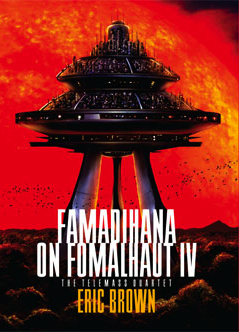
volume8 frontHere are the covers for my next two books, Strange Visitors, a collection from NewCon Press, and the novella Famadihana on Fomalhaut IV, from PS Publishing. Strange Visitors collects ten short stories and contains an original “P.O.O.C.H.”, written especially for this volume – a semi-autobiographical (in the loosest sense) account of owning a dog. Last year we acquired Uther, a red and white setter, and our lives have never been the same. The fine cover by Jim Burns illustrates one of the stories, “Bukowski on Mars, with Beer”, and shows Buk on Mars… with beer. Famadihana… is the first in the Telemass Quartet, each novella following Matt Hendrick as he Telemasses to a different colony world in search of his ex-wife and daughter. The stunning cover, showing the Telemass Station against a fulminating red giant, is by Tomislav Tikulin.


Both titles are out next month, April, and will be launched at EasterCon in Glasgow. NewCon Press and PS Publishing will be hosting a joint launch party for a number of their titles on Friday the 18th. I plan to get over from Dunbar, so hopefully I’ll see you there.

* * *

famadihana-on-fomalhaut-iv-signed-jhc-eric-brown-2075-pThe next novel, a steampunk adventure, Jani and the Greater Game – volume one in the Multiplicity series – is almost finished. I have a little fine tuning to do, then I’ll submit it later this month. This is one of those happy books which almost wrote itself, as if Jani herself were dictating the narrative. If all novels came as easily!

On the short story front, I’ve recently had tales appear in Daily SF and MoonShots. Forthcoming are stories in Gary Dalkin’s Improbable Botany, and a story written with Keith Brooke which will appear in Ian Whates’ anthology about the Fermi paradox, both later this year.

3 Comments

Filed under News

Novel News

The pleasing news at this end is that Solaris have commissioned a second Jani steampunk novel. Here’s the press release from my agent John Jarrold.

PRESS RELEASE – SOLARIS COMMISSION SECOND ERIC BROWN STEAMPUNK NOVEL

Jonathan Oliver, commissioning editor of Solaris Books, has commissioned a sequel to JANI AND THE GREATER GAME, the first in a new steampunk series by Eric Brown, set in India with a teenage female protagonist.  The first novel will be published in autumn 2014, with the sequel following a year later. The agent was John Jarrold, and the deal was for UK/US rights.

Jonathan Oliver said: “Eric is one of those SF writers who constantly pushes the boundaries, and with this steampunk series, set mainly in India, he’s producing a fresh take on a genre that often revels too heavily in nostalgia. Eric continues to prove that he is one of the UK’s premier writers of entertaining and thought-provoking SF.”

It’s been a good couple of weeks. Before this commission came the news from Severn House that they’ve bought the follow-up to my first crime novel. Murder at the Chase will be published next year. It’s the second book in the series featuring the amateur detectives Donald Langham and Maria Dupré, set in 1955. I love writing these books, a change of gear from the SF and a chance to pay homage to all those Golden Age crime writers that started me reading back in the 70s.

And on the short story front, NewCon Press will be bringing out my collection, Strange Visitors, in their Imaginings series. The volume will comprise ten stories – one of which will be an original – and my introductions to each tale. It’s due out next Easter.

At the moment I’m steaming ahead on the first draft of Jani and the Greater Game. Our heroine is in great danger as I type – so I’d better get back and rescue her from her evil pursuers.

3 Comments

Filed under News

A Busy September

September was something of a busy month. In August we bought a red and white setter puppy and it proceeded to create havoc in the household. We had been warned that puppies were life-changing – much like having a child – but no amount of forewarning quite prepared us. As I work from home, the brunt of Uther’s care falls upon me. Perhaps in a bid to prove to myself that I could work in adverse conditions – and that the tiresome routine of dog-care would not blunt my creativity – I set out to write as many short stories in September as I could.

The result was that I wrote ten. I’ve never before managed that level of productivity. Okay, seven of them were short-shorts, between one thousand and fifteen hundred words long – but the others consisted of a 16k novella, an 8k story, and one at 4k. The novella was about a far future world where the seas have vanished and the remnants of humanity scrabble for existence in deep canyons that were once the ocean bottoms. The long story was more autobiographical: it’s about a dog, and its intrusion into the life of a computer hacker. It occurred to me that in future convicts might not be imprisoned but given robotic dogs instead. The 4k story was not SF but a detective tale about a man with a peculiar ability and how it helps him to solve the theft of a work of art from a London gallery. Among the seven short-shorts are the first ever zombie story I’ve written, my first outright fantasy (about a genie and the wishes he grants the President of the USA), and a science fiction tale about a near-future America where the gun lobby have even more power than they do now…

The novella, provisionally entitled “Beneath the Ancient Sun” will appear from Infinity Plus Books next year in a collection of four of my longer stories and novellas, Rites of Passage, and “P.O.O.C.H.” will appear in my collection Strange Visitors from NewCon Press next Easter. The remaining tales will be submitted to various magazines when I’ve knocked them into shape.

And Uther, who is sitting on the floor gnawing at my chair as I type, sat through this burst of productivity with only the occasional interruption.

Leave a comment

Filed under News

Jani and the Greater Game

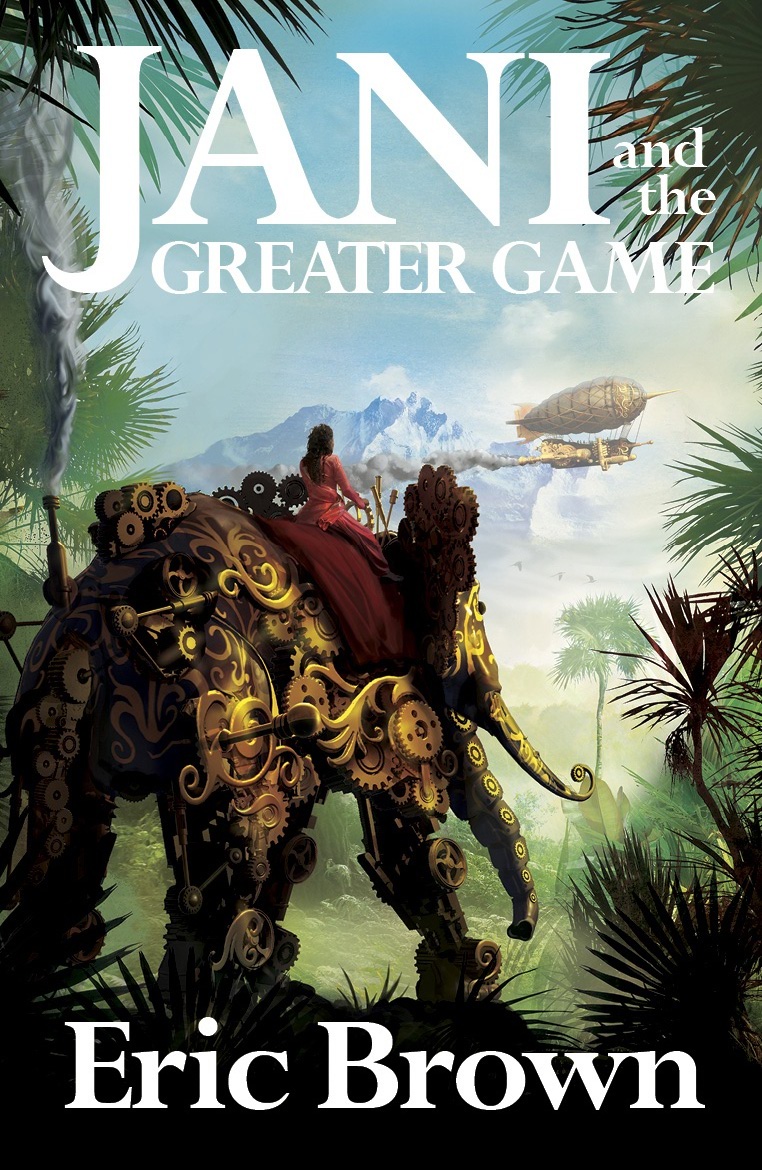
JaniHere’s the cover of Jani and the Greater Game, the first volume of a steampunk series set in India in 1925. I think Dominic Harman’s done a fantastic job in capturing the feel and atmosphere of the novel. He did the cover of my last one, too (and many more of mine besides): The Serene Invasion, which just might be my all time favourite Harman.

Jani… marks a bit of a departure for me. I’ve never written a steampunk novel before, and never written an adult novel from the point of view of a woman… and certainly not an Indian woman. Should be interesting.


6 Comments

Filed under News

Latest news

On the short story front I have a few tales appearing in the following venues:

“Bartholomew Burns and the Brain Invaders” in Aethernet.

“Diamond Doubles” in Daily SF.

“The Ice Garden” in Improbable Botany.

“Emotion Mobiles and Sally” in Starship Seasons.

“Iris and the Caliphate” in Fifteen.

salvage-ebook-cover_600wInfinity Plus Books will be bringing out my episodic novel Salvage, which will feature the following original stories: “The Manexan Exodus”, “To All Appearances”, “Salvaging Pride”, and “End Game”, featuring Salvageman Ed, Ella and Karrie.

* * *

Friend and fellow SF writer Chris Beckett has won the 2013 Clarke Award for his fabulous novel Dark Eden. I’m sorry I won’t be at the Pickerel in Cambridge to celebrate, Chris, but I’ll be raising a pint in spirit. Well done! The sequel to Dark Eden, Gela’s Ring, is being serialised in Aethernet, and will be published by Corvus.

* * *

The 2013 Philip K Dick Award was won by Lost Everything by Brian Francis Slattery (Tor Books), and a special citation was given to Lovestar by Andri Snær Magnason (Seven Stories Press). Congratulations to both writers. My Helix Wars and Keith Brooke’s alt.human were short-listed.

* * *

The new online serial SF magazine, Aethernet, edited by Tony and Barbara Ballantyne, was recently launched at Eastercon in Bradford. It’s full of excellent work by the likes of Chris Beckett, Ian Whates, Philip Palmer and others. A long tale by me will be running in later issues. For more information: www.aethernetmag.com

* * *

Welcome to my revamped website – and a big thanks to Keith Brooke for setting it up and being patient with my IT ineptitude.

Speaking of Keith Brooke… While the website was down, I heard the happy news that my novel Helix Wars and Keith’s alt.human (Harmony in the US) have been short-listed for the Philip K. Dick award. So I have two shots at winning… or that’s how it feels, at any rate. Keith is a great friend, and I feel privileged to have been among the first readers of alt.human. The winner will be announced in Seattle on the 29th March.

It’s been a busy few months on the writing front, and the next few months will see a few books hot off the presses. Later this month my first foray into crime is due out. Murder by the Book (Severn House) breaks new territory: it’s a crime thriller set in London in 1955 and features thriller writer Donald Langham and his literary agent Marie Dupré, and their involvement in a series of murders in the London crime writing scene. It was fun to write – I could use simile and metaphor with much greater freedom than I have when writing SF, and it was nice to write in a ‘real’ world known to the reader. I’ll be writing the second book in the series later this year.

Also later this month comes the sumptuous Drugstore Indian Press edition of the collected Starship novellas, Starship Seasons, with a great… laid back, let’s say… cover from Tomislav Tikulin. Later this year will appear the hardback edition containing an original long short story, wrapping up events at Magenta Bay…

In May is the big one, The Serene Invasion, from Solaris, about aliens who invade, peaceably, and change things on Earth for ever. It’s about non-violence and hope, and was the hardest thing I’ve had to write for years. It’ll be graced by a wonderfully atmospheric cover by Dominic Harman.

And later this year the second book in the Weird Space series, Satan’s Reach, is released from Abaddon Books. This one was great fun to write and whistled out, and tells the story of telepath Den Harper and the bounty hunter he’s running from across the expanse of the Satan’s Reach.

Later this year Infinity Plus Books will bring out the collected Salvageman Ed stories, fixed up to read as a novel. I’ve yet to settle on a suitable title for this; so it’s simply Salvaging at the moment.

* * *

And this has just come in from my agent, John Jarrold…

PRESS RELEASE – SOLARIS COMMISSION ERIC BROWN STEAMPUNK NOVEL

Jonathan Oliver, commissioning editor of Solaris Books, has commissioned JANI AND THE GREATER GAME, the first in a new steampunk series by Eric Brown, set in India with a teenage female protagonist.  The novel will be delivered in spring 2014, for an autumn publication. The agent was John Jarrold, and the deal was for UK/US rights.

Eric Brown said: “I’m delighted and excited to be doing a ideatively different novel set at the end of the nineteenth century. It’ll be my first novel-length venture into the exotic territory of steampunk, and I’m already pulling on my plus-fours and brass-studded thinking cap. I love writing about India, and in Janisha Chaterjee I have a strong female lead who subverts all the norms – this will be steampunk done with spice!”

12 Comments

Filed under News

Latest news

Introduction to Ghostwriting, a collection of horror stories:

I write very few short stories that can be termed horror, ghost, supernatural, occult, or fantasy. In fact, in a career spanning twenty-five years I’ve written just eight (nine, if you include the novella A Writer’s Life) out of a total of around a hundred and twenty published stories. Most of those have been science fiction, a genre with which I feel more comfortable. The ideas I have just happen to be about the future, concerning the staple tropes of the genre: other worlds, space-flight, aliens, fantastical technologies, time-travel… I rarely get ideas that fit neatly into the horror genre or related sub-genres.

Now, why is this?

Perhaps it’s because my preferred reading, along with mainstream novels, is SF. I’ve been reading it since I was about fifteen and I know it inside out. I do occasionally read horror (or ghost or supernatural), and enjoy the likes of Robert Aickman, R. Chetwynd-Hayes, M.R.James, and more modern practitioners like Joe Hill, T.E.D. Klein, Adam Nevill. And while I can appreciate the literary merits of the genre, I always have to work hard at suspending my disbelief. Fundamentally, I don’t believe in the occult, ghosts, ghouls, vampires, etc… Therefore when I come to write about them, I find it that much more difficult to do so.

Now I can hear you crying, “Why! That’s ridiculous! What makes ghosts, ghouls, vampires etc any less credible than little blue aliens, FTL travel and all the other fantastical trappings of SF?” And I admit that there is, perhaps, nothing more credible about the furniture of SF… other than a sneaking suspicion I have that the things I write about in SF might, just might, possibly, in some way, at some point in the future, come to pass. At any rate, the characters I write about in my science fiction tales believe implicitly in the scientific process and believe that the fantastical things in their world have a credible, rational, scientific basis.

When I do get ideas for horror tales, I find that they’re about the exploration of character. They’re gentle horror tales, often metaphorical, with little or no blood and guts, precious few ghosts, ghouls, and certainly no werewolves or vampires. I prefer to call them psychological horror stories.

* * *

Helix Wars

At the moment I’m working on a follow up to my 2007 novel HelixHelix Wars will be set two hundred years after the events described in Helix – the arrival of the human colonists on the vast, helical construct made up of ten thousand worlds. In the new novel, the human race have the job of keeping the peace among the six thousand inhabited worlds of the Helix. However, when the humanoid Sporelli invade the neighbouring world of Phandra, the humans are drawn into a conflict that will have far-reaching consequences for all those involved.

Here’s the publisher’s blurb:

The Helix: a vast spiral of ten thousand worlds turning around its sun.

Aeons ago, the enigmatic Builders constructed the Helix as a refuge for alien races on the verge of extinction. Two hundred years ago, humankind came to the Helix aboard a great colony ship, and the Builders conferred on them the mantle of peacekeepers. For that long, peace has reigned on the Helix. But when shuttle pilot Jeff Ellis crash-lands on the world of Phandra, he interrupts a barbarous invasion from the neighbouring Sporelli – who scheme to track down and exterminate Ellis before  he can return to New Earth and inform the peacekeepers.

Helix Wars, sequel to the best-selling Helix, is a fast-paced adventure
novel about the ultimate threat to the Helix itself.

I’m sixty thousand words into the story, and it’s going well. I should have a first draft in the bag by the end of January – with a break for Christmas and the move north to Dunbar, East Lothian. Delivery date is mid-May, and publication is slated for October 2012.

How I work on longer, multi-viewpoint novels – and Helix Wars will probably have four POV characters – is to write each individual’s story in one linear block, taking him or her through the story until near the end. I then slice up the sections and interleave, rewriting to create cliff-hangers, tension etc. Then I write the finale. It’s not how every author goes about writing multi-viewpoint novels, but, as they say, it works for me.

* * *

E-Books

Several of my titles are now available as e-books.

My first novel Meridian Days, the novellas A Writer’s LifeApproaching Omega, the short stories “The Time-Lapsed Man” and “The Death of Cassandra Quebec”, along with my new collection The Angels of Life and Death, are all at Keith Brooke’s infinity plus imprint. Due out soon is my novel Penumbra.

www.infinityplus.co.uk/books

The first volume of the Virex trilogy, New York Nights, is now at Anarchy Books run by Andy Remic:

www.anarchy-books.com

My PS Publishing titles should be available soon from PS Publishing E-Books.

* * *

On the short story front, I have tales due out from Postscripts, Albedo One, The Hub, Andy Remic’s E-anthology Vivesepulture, and Daily SF.

* * *

My next book out, from Abaddon, will be The Devil’s Nebula, summer next year…

Starship Captain Ed Carew and his crew of two – ex-marine Lania Takiomar and ex-convict Gord Neffard – lead a carefree life of smuggling, gun-running and other illicit pursuits in a far future ruled by the fascistic Expansion Authority. But when an Expansion judiciary ship captures Carew and his crew leaving the planet of Hesperides, an out-of-bounds world governed now by the fearsome Vetch extraterrestrials, Carew, Takiomar and Neffard are sentenced to death…

Unless the agree to travel through Vetch territory in pursuit of an human colony vessel which set off for the Devil’s Nebula one hundred years ago.

But why are the Expansion authorities so eager to track down the ship, will Carew and co. survive the journey through Vetch territory – and what might they find when they arrive at the Devil’s Nebula?

The Devil’s Nebula is the first book in a thrilling space opera series, The Weird.

An evil race is threatening not only the human Expansion, but the Vetch Empire, too – an evil from another dimension which infests humans and Vetch alike and bends individuals to do their hideous bidding.

And only if humans and Vetch cooperate to fight of the fearsome Weird do they stand a chance of ensuring their survival…

* * *

My story “The House” was published in the anthology House of Fear, edited by Jonathan Oliver. It a rare (for me) excursion into horror territory, though the story is more psychological horror than out and out gore. Anyway, I think it’s the best tale I’ve written for some time.

* * *

The infinity plus and friends sampler/anthology, infinities, is now
available – free –  from:
www.infinityplus.co.uk/infinities

containing work by Linda Nagata, Scott Nicholson, Kristine Kathryn Rusch, Steven Savile and others.

* * *

The Kings of Eternity:

1999, on the threshold of a new millennium, the novelist Daniel Langham lives a reclusive life on an idyllic Greek island, hiding away from humanity and the events of the past. All that changes, however, when he meets artist Caroline Platt and finds himself falling in love. But what is his secret, and what are the horrors that haunt him?

1935. Writers Jonathon Langham and Edward Vaughan are summoned from London by their editor friend Jasper Carnegie to help investigate strange goings on in Hopton Wood. What they discover there – no less than a strange creature from another world – will change their lives forever. What they become, and their link to the novelist of the future, is the subject of my most ambitious novel to date. Almost ten years in the writing, The Kings of Eternity is full of the staple tropes of the genre and yet imbued with humanity and characters I hope you’ll come to love.

It’s already garnered a lot of great reviews, among which:

http://scotspec.blogspot.com/2011/03/book-review-kings-of-eternity-by-eric.html

Leave a comment

Filed under News